Understanding Percentages and Decimals
Percentages and decimals might seem intimidating, but they're just different ways to represent parts of a whole. A percentage shows a portion out of 100; for example, 50% means 50 out of 100. A decimal uses a point to separate whole numbers from parts less than one; 0.5 represents one-half. Understanding this relationship is key to converting between them. Think of a pizza cut into 100 slices – each slice is 1%, and 0.01 as a decimal.
Converting Percentages to Decimals: The Simple Method
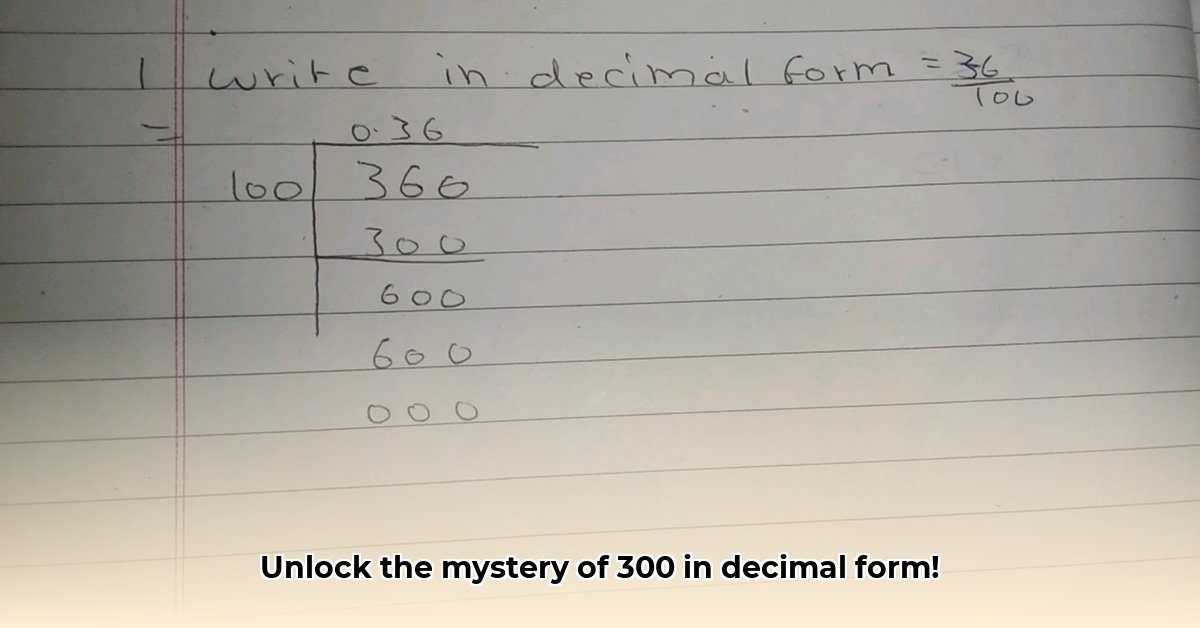
The core trick to converting percentages to decimals involves a single, straightforward step: divide by 100. This works because percentages are inherently fractions with 100 as the denominator. Dividing by 100 effectively removes the "%" symbol and transforms the percentage into its decimal equivalent.
Let's illustrate with 300%:
- Start with your percentage: 300%
- Divide by 100: 300 ÷ 100 = 3
- The result: 300% as a decimal is 3.0
This method applies universally, irrespective of whether the percentage is greater than or less than 100%.
The Shortcut: Moving the Decimal Point
There's an even quicker way! Dividing by 100 is the same as shifting the decimal point two places to the left. Every whole number implicitly has a decimal point at the end.
Consider 25%:
- Identify the implicit decimal: 25.
- Shift the decimal two places left: 0.25
- Result: 25% as a decimal is 0.25
This shortcut streamlines the conversion process, particularly useful for many quick calculations.
Deeper Understanding: Place Value and Fractions
The conversion process is fundamentally linked to place value. In the decimal 0.25, the '2' represents two tenths (2/10), and the '5' represents five hundredths (5/100). This directly relates to the fractional representation of percentages. For instance, 25% is 25/100, which simplifies to 1/4, representing one-quarter of a whole.
Handling Percentages with Decimals
Converting percentages that already contain decimals follows the same principle – divide by 100 (or move the decimal point two places to the left). Let's examine 12.5%:
- Start with the percentage: 12.5%
- Divide by 100 (or move the decimal point two places left): 0.125
- The outcome: 12.5% as a decimal is 0.125
Real-World Applications: Why This Matters
This seemingly simple conversion is essential for various real-world applications, from calculating discounts and sales tax to interpreting financial data and understanding statistical results. Mastering this skill equips you to readily analyze numerical information presented as percentages. Is it useful for your budget? Probably!
Avoiding Common Mistakes
A common mistake is misplacing the decimal point. Always remember to move it two places to the left. Another error is dividing by 10 instead of 100. Finally, for percentages less than 10%, remember that a leading zero is needed (e.g., 5% is 0.05).
Key Takeaways
- Percentages represent parts of a whole (based on 100).
- Converting percentages to decimals involves dividing by 100.
- A shortcut is moving the decimal point two places to the left.
- Understanding place value is crucial for accuracy.
- Common errors include incorrect decimal placement and dividing by 10 instead of 100.
- Consistent practice enhances proficiency.
Through understanding the underlying principles and employing these simple techniques, you can confidently convert any percentage into its decimal equivalent.